Wednesday, August 8, 2012

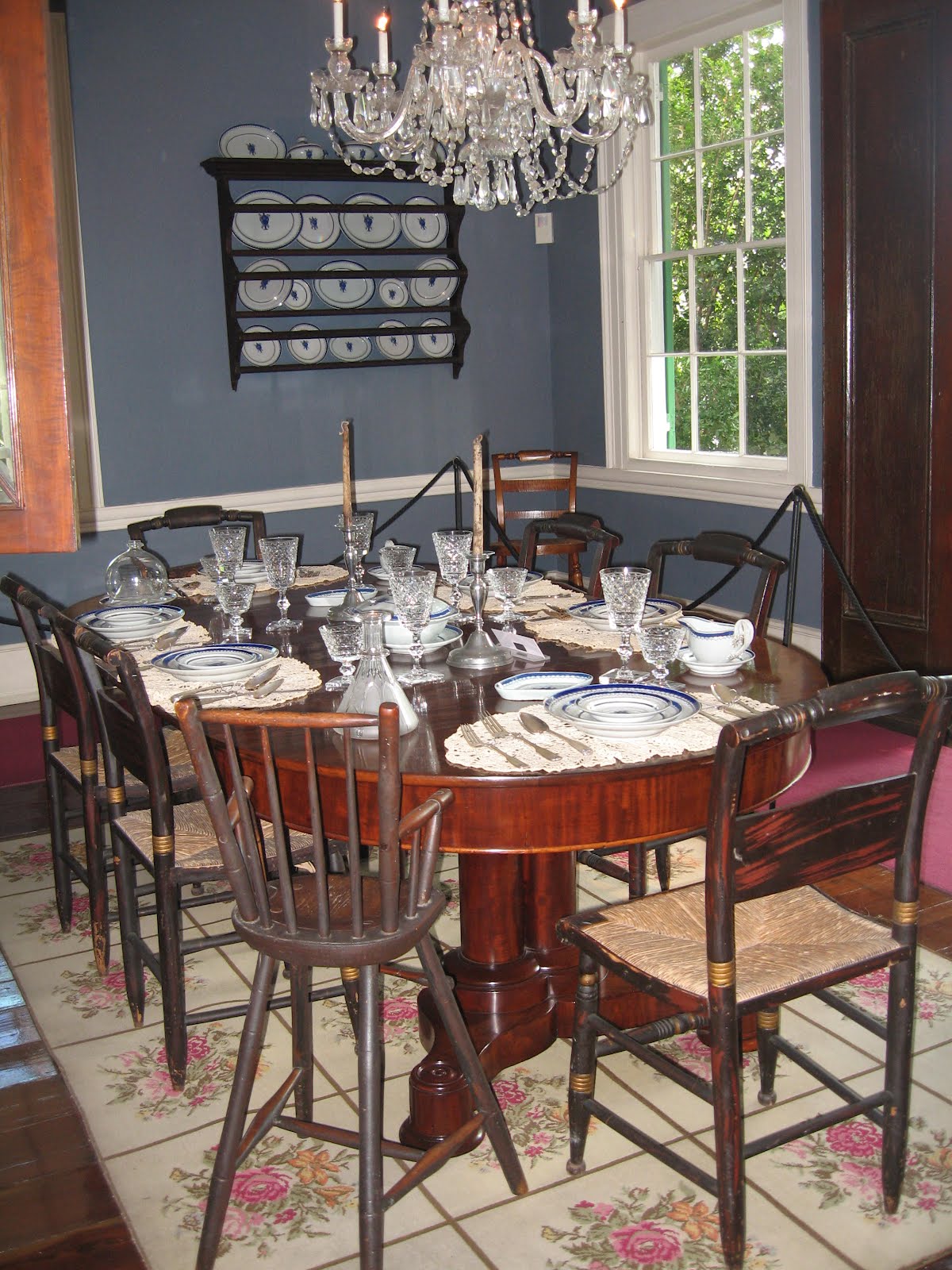
Captain David Judson House

Stratford, CT


What's a young aspiring preservationist to do during the dog days of summer?  Those in Stratford, CT attend the annual history camp.   The week long camp for fourth graders through high school teaches kids about life in the 1700's.  The campers learn about butter making, candle dipping, weaving, and herb gardening.  They can become junior docents and on the last day of camp lead family and friends on a tour of the home.

My recent tour was lead by Pam and the junior docent of the day, Emily. They were both very knowledgeable about life in the 1700's and the many tools, farm implements, and household products of the day.  In fact my overall impression of the home was not about the family that lived there but about the many artifacts of the time period.  I  could probably skip camp and go right to the junior docent position.

Highlights for me:

*  The bulls eye glass in the front door was probably made in England.  In the 1750's, due to British Parliamentary regulation not expertise, glass was not made in the US.

*  As your candle burns down it becomes more difficult to read your book or sew but if you have this handy little table/candle holder that twists up and down like a screw you'll hold onto that light a little bit longer.

*  Privacy is something very important to us today.  But that wasn't true during colonial times.  In the Judson House living room is a corner chair or chamber pot chair.  There was no need to clear the room if you needed to "use the facilities".  Just pick up the chair top and then your dress.

*  Candles were made from meat fat so in addition to emitting a distinctive odor they were attractive to mice and thus kept on the wall in a metal candle keeper.

*  The coming and going room.  Love the name.  So simply states its purpose.  Birthing and dying.

*  Tea!  We all know how big a thing that was in the colonies and in the Revolutionary War! Somehow  tea was condensed into rock solid bricks that were shaved to create a small amount of loose tea to use for brewing.  The house has two tea blocks.  One brick was about 1 X 2 inches and the second one was huge at maybe 5 X 8 inches.  Both had an intricate design stamped onto the front.

I'm beginning to see an interesting thread in my tours and reading.  The stories of how buildings are saved and rehabbed are themselves fascinating pieces of history.  In 1925 the Judson House was given by the Curtis sisters to the town of Stratford.  The gift included a stipulation that the town raise $10,000 for upkeep and maintenance.  With an astonishing $13,000 Stratford surpassed the goal and the local Historical Society was born.


Sunday, August 5, 2012

Ally Quest


Love my membership with the National Trust for Historic Preservation!  It keeps me up to date with news in the preservation world, introduces me to new places, and helps support the kind of historic preservation that's important to me.

I found Ally Quest as I was "thumbing" through my E Newsletter from the Trust.  At first glance I thought this would be me and my blog on video.  Travel and history - Ally's thing and mine.  But if you know me and my blog and check out Ally and her video, we're not exactly twin like.  Yet we evidently do have something in common.

As Ally says: "Experience what it's like to live in another decade.  Explore towns that time has forgotten, restaurants that are really relics of the past, hotels with a place in history, significant spots that still exist today and hold a real glimpse into another time."  Those are all things I like to do on my vacations.  I've just narrowed down my chronicling to house museums.

Check out Ally's episode on Catalina Island that features the Inn on Mt Ada, a Wrigley Mansion. http://www.youtube.com/watch?v=bentTSsxOWI&feature=plcp Then take a look at my blog entry on the Wrigley Mansion in Phoenix, AZ.  (4/6/09)

I've sent her a link to my blog.  Why not?  It's a great source for future Ally Quest episodes.  You'll be the first I'll shout out to if anything develops.  Is there a video guest appearance in my future??

Tuesday, July 31, 2012

Audubon House and Tropical Gardens

Key West, FL


We were off to Florida's Gulf coast but ducked into the Audubon House as we passed by on a walk.  Happy we did!

The home was never owned by John Jay Audubon, the acclaimed ornithologist and naturalist, but is known for him because he stayed with the owner of the home, Captain John H Geiger, when he visited Key West in 1832. During his visit Audubon identified 18 new birds found in the Key's for his "Birds of America" folio.  Some of his most famous drawings were done at the home and the Geiger tree, appearing in Audubon's painting of the white-crowned pigeon, was in the front yard of the home. The second floor of the home displays original hand watercolored lithographs and engravings that are available for purchase.

The other interesting story link here is Captain John Geiger who was a prosperous  Key West harbor pilot and master wrecker.   I quickly caught onto the meaning of harbor pilot but what's a master wrecker?  Google's first choice was auto towing but not far behind came maritime towing and salvage.

In a blog post on June 1, 2010 the author, Cate Masters, listed her top 10 interesting facts about wreckers. I thought they were pretty interesting too.   http://harveyle.blogspot.com/2010/06/apa-cate-masters.html

1. Wreckers plied their trade not only in Key West, but in the Bahamas, and as far away as the United Kingdom. 

2. Because so little diving equipment had been invented, wreckers salvaged ships’ cargoes from the bottom of the sea the hard way – holding their breath for several looong minutes. 

3. Though some claim wreckers set traps for wayward ships, no evidence backs this up. 

4. In the mid 1800s, nearly one ship a week wrecked off the coast of Florida. 

5. Wreckers known as Conchs came from the Bahamas, but were of English descent. 

6. Some wreckers lived to ripe old ages, but many perished from drowning, shark attacks, boating accidents or, in the earliest days, at the hands of pirates or Seminole Indian massacres. 

7. Because Key West men outnumbered women by ten to one, many wreckers married the women they saved from watery graves. One ship became known as the Ship of Brides, its German passengers marrying wreckers, including a widow and her daughters. 

8. Average shares earned by individual wreckers amounted to hundreds of dollars per shipwreck. Imagine how much money that translates to in current dollars! 

9. Wreckers followed 13 rules of their trade, but the unwritten rule was to rescue a ship’s passengers first, then its cargo. 

10. The Florida wrecking industry continued until the early 1900s. 

The Audubon house is another home that was slated for demolition but saved.  In 1958 the Wolfson Family Foundation spearheaded the drive to save and restore the home.

Tuesday, July 17, 2012

Harry S Truman Little White House

Key West, FL


It doesn't look like a house from the outside.  Maybe that's because it was built in 1890 by the U.S. Navy to house the base commander and paymaster.   Yet inside with the aid of an engaging and well informed tour guide the house certainly felt like a Presidential retreat.

Truman spent 175 days in residence from 1946 to 1952 using it both as a retreat and functioning White House.  John F Kennedy, Jimmy Carter, Bill Clinton, Colin Powell also either stayed in the home or used it for meetings.  And during World War I Thomas Edison lived there while conducting experiments and developing weapons for the Navy.

Don't miss the official website www.trumanlittlewhitehouse.com.  Among other things there's a list of 11 logs chronically Truman's visits to Key West.  I chose to read "Log of President Truman's Fifth Trip to Key West : Nov 7-21,1948.  Log No. 5. " It's a detailed view of exactly how he spent his time on this two week trip.  Here's a few highlights:

* The President lost his eyeglasses while swimming in heavy surf.  They were recovered later when he noticed them at the water's edge.

* Mrs Truman and Margaret left for Havana aboard the Williamsburg at 8:30 A.M.  The Ambassador and Mrs Butler first greeted them aboard the ship and then escorted them on a sightseeing tour of Havana.  The Trumans rested on the ship in the afternoon and returned to shore to an afternoon tea at the American Embassy.  At 11 P.M. the Williamsburg began the return trip to Key West.

* The fishing parties were often quite successful, catching barracuda and grouper.

* The president rarely watched the movies that were shown nightly in the living room.   However on the first night of his wife and daughter's stay he joined them to watch "Apartment for Peggy" starring Jeanne Crain.  He did often watch newsreels especially those reporting on his recent reelection.

* The morning of his wife and daughter's arrival the President shaved his vacation stubble.

There's a chart at the end of the tour showing the results of an historians' evaluation of Presidential leadership.  Fascinating to see that Truman's star has risen over time to now place him near the top at #5.


Friday, July 13, 2012

Hemingway #2

Family room couch, CT

This post is a little late and perhaps a bit early.  Just after posting about the Hemingway House and Museum in Key West, FL we watched the HBO movie Hemingway and Gellhorn on demand T.V.    And wow is the home accurately portrayed in the movie.  Remember the antelope head on the wall in my blog photo?  There it was on the living room wall in the movie.  And those enormous green shutters, and the cats?  All there.  The home came alive in the movie. When I visited the totally distracting actor / guide and crowds made that impossible.

Watching the movie I was sorry to see Ernest leave his wife Pauline in Key West to go off to the Spanish Civil War - no more views of the house!  Well perhaps that's not true.  We haven't yet finished the movie.  Maybe they'll go back to the Key West home at the end of the movie.  Better keep watching.

Saturday, June 30, 2012

At Home With Frank Lloyd Wright


I've been hanging around the periphery of the Frank Lloyd Wright fan circuit.  I've toured Taliesin East and West, his Oak Park home and neighborhood, Fallingwater, and the Guggenheim Museum.  I've read the two recent historical fiction accounts of his personal life along with anything else in the newspaper or preservation news.  And I've dream of seeing more of his work, noting in this blog a list of FLW homes that you can rent on vacation.

But here's something new.  A 2000 foot gallery opened on June 2 in the FLW designed SC Johnson Administration Building in Racine, Wisconsin.  (scjohnson.com/visit)  The gallery will have rotating exhibits with FLW's "designs and artifacts, and will explore his influence on families and the American home".

The chief curator of the inaugural exhibition, "At Home With Frank Lloyd Wright, said it seeks to illustrate FLW "radical deviation from Victorian architecture by opening floor plans, connecting with nature, using natural materials and not hiding them with paint or wallpaper."

Sounds fabulous.  Best of all, I have to admit, they seem to have liked my blog title,
At Home With House Museums !

Monday, June 18, 2012

Hemingway Home and Museum

Key West, FL


Look at the line to get into this house museum!  I should have told them to forget it.  Go a mile and a half up the road to the Truman Annex.  That's worth the visit!

It's very unusual for me not to like a house museum.  In fact I can say I'm happy to have seen this one but mostly to cross it off my list.  But that's not saying much, is it?

What didn't I like?  It was all business and was it doin business! There were so many people visiting first thing in the morning that there was a line to get in.  My tour group members gathered in the dining hall.  As we moved about we were sometimes forced to take a different route because another group was already in the room we wanted to see or we waited single file for others to pass us so we could proceed into the room or up the stairs.  It's a compact home on standard lot and on most days I'll bet its overflowing with tourists.

And then there was the tour guide!  He has to be an underemployed or perhaps formerly employed actor.  The tour was really his opportunity to run his lines by us.  The Hemingway Home website has a little bio, just like in a playbill, on each tour guide.  I don't believe this was my guide but here's part of the bio on another guide: "describes himself as an "edutainer." His philosophy is that if he can touch as many lives as possible, however briefly, and have people smile, he is doing something worthwhile with his life. Joe would like you to know that he has completed over 6,000 public performances at the museum." 

And unlike most house museum guides our guide wasn't interested in our questions, either before or after his spiel.  But he was interested in tips!  He had an especially distasteful little shtick at the end of the tour when he asked for tips.

Actually a good question.  Should you tip house museum tour guides?  I don't believe I ever have.


a descendant of Hemingway's six-toed cat


Hemingway wrote many of his classics while living in Key West.  They include: Death in the Afternoon, Green Hills of Africa, To Have and Have Not, For Whom the Bell Tolls, and The Fifth Column.  This small second floor room in a smaller building at the back of the property is where he preferred to write early in the morning.