Nancy, the chairwomen of the Museum committee, very kindly responded to the question about the Josiah Dennis Manse in my last blog entry.
"The round stone at the front door is one half of a millstone. The other half is at a door at the back of the Manse. If you visit a working grist mill (There is one in Sandwich, MA) you will see this kind of mill stones actually grinding the corn."
Wish I had a picture of the back door for you.
What I do have and will blog on at some point is exterior and interior photo's of the 1745 school house that is on the property.
Friday, October 7, 2011

Sunday, October 2, 2011
Josiah Dennis Manse Museum
Dennis,MA

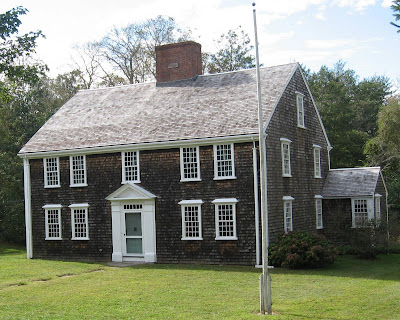
Missed this house museum by one day on my first visit to the Cape this June and you may have visited before me if you read the July 26 post to this blog. The Josiah Dennis Manse Museum held its grand reopening after the town of Dennis completed a 2.7 million dollar five year restoration. So the home was a must see on our September return trip to the Cape.
The incredibly well informed guides held our attention with stories about the home, its inhabitants, and maritime life on Cape Cod. But there was one particular story that we all focused on.
Floating lighthouses were once used to keep ships safe from shallows,reefs and other treacherous waters. They were in use between 1820 and 1985 with the heyday being 1909. At least initially they were without they're own power and were hauled out to the site by another boat. They were eventually replaced by buoys, LNB's(large Navigational Buoys)or Texas Towers.
Back in 1918 the Cross Rip Lightship with 6 crew members on board was towed to its post in the Tuckernuck Shoals. After a long winter the boat became encased in a frozen sea. The First Mate walked a long 3 miles back to shore to ask permission to abandon the Cross Rip before the boat was washed out to sea as the granite anchor had been pulled loose in the melting ice.
The owners refused permission to abandon the ship reminding the mate of the lightship creed "You have to go out; you don't have to come in." Chilling!
And they didn't come in. A few months later a rudder and American flag from the Cross Rip lightship washed ashore.
Want to tour a lightship? There's one berthed at Jack London Square in Oakland,CA that's open for weekend public tours. Or maybe you'd rather read about them. Try Lightships: Floating Lighthouses of the Mid-Atlantic Coast by Wayne Kiklin published in 2007.
One of the best parts of my visit was the discussion in the car on the way home. Mostly I just sat and listened to my 3 companions discuss what they really enjoyed and what was most remarkable about our visit. It was energizing to see others get excited about this house museum. It happens to me all the time.
Here's a little check list for your tour. If your guide doesn't tell you first then be sure to ask about:
* What's strange about the shadow box portrait of Nathan Stone Jr?
* How many other US towns are named after its first minister?
* Why both young boys and girls learned stitchery?
* Why Lulu the pony sailed the seas on a clipper ship?
* Why smoking pipes were made to be broken multiple times?
* How one slept tight on a rope bed?
One more question to June or Nancy. Can you tell me something about the beautiful front step or round stone? I saw something similar, though not as grand, at another Cape house museum.


Missed this house museum by one day on my first visit to the Cape this June and you may have visited before me if you read the July 26 post to this blog. The Josiah Dennis Manse Museum held its grand reopening after the town of Dennis completed a 2.7 million dollar five year restoration. So the home was a must see on our September return trip to the Cape.
The incredibly well informed guides held our attention with stories about the home, its inhabitants, and maritime life on Cape Cod. But there was one particular story that we all focused on.
Floating lighthouses were once used to keep ships safe from shallows,reefs and other treacherous waters. They were in use between 1820 and 1985 with the heyday being 1909. At least initially they were without they're own power and were hauled out to the site by another boat. They were eventually replaced by buoys, LNB's(large Navigational Buoys)or Texas Towers.
Back in 1918 the Cross Rip Lightship with 6 crew members on board was towed to its post in the Tuckernuck Shoals. After a long winter the boat became encased in a frozen sea. The First Mate walked a long 3 miles back to shore to ask permission to abandon the Cross Rip before the boat was washed out to sea as the granite anchor had been pulled loose in the melting ice.
The owners refused permission to abandon the ship reminding the mate of the lightship creed "You have to go out; you don't have to come in." Chilling!
And they didn't come in. A few months later a rudder and American flag from the Cross Rip lightship washed ashore.
Want to tour a lightship? There's one berthed at Jack London Square in Oakland,CA that's open for weekend public tours. Or maybe you'd rather read about them. Try Lightships: Floating Lighthouses of the Mid-Atlantic Coast by Wayne Kiklin published in 2007.
One of the best parts of my visit was the discussion in the car on the way home. Mostly I just sat and listened to my 3 companions discuss what they really enjoyed and what was most remarkable about our visit. It was energizing to see others get excited about this house museum. It happens to me all the time.
Here's a little check list for your tour. If your guide doesn't tell you first then be sure to ask about:
* What's strange about the shadow box portrait of Nathan Stone Jr?
* How many other US towns are named after its first minister?
* Why both young boys and girls learned stitchery?
* Why Lulu the pony sailed the seas on a clipper ship?
* Why smoking pipes were made to be broken multiple times?
* How one slept tight on a rope bed?
One more question to June or Nancy. Can you tell me something about the beautiful front step or round stone? I saw something similar, though not as grand, at another Cape house museum.

Tuesday, September 27, 2011
Winslow Crocker House
Yarmouth Port, MA
You know you're not in just any house museum when there's a large basket of blue booties awaiting you at the front door. It's a sign that more than usual care is being taken to protect the floors and rugs that you're about to trample on.
This 2 story Georgian style house was built in 1780 by Winslow Crocker,a wealthy trader, land speculator and rumored rum runner. As you can see from the photo this is a handsome and sizable building with large rooms. Compare it to other homes of the era and it becomes even more impressive.
Go back to the June 22, 2011 At Home posting for the early 1800's Caleb Nickerson House in Chatham. That comparison helps identify the Crocker house as a true McMansion of it's time.
Crocker died in 1821 and left the house to his two sons. The sons managed to live totally separate lives while sharing the same house. The solution - divide the home vertically by building a wall that split rooms and fireplaces in two.
The Crocker family continued to own the home until the 1930's when it was purchased by Mary Thatcher, the descendant of another original Yarmouth settler. Ms Thatcher, a philanthropist with a passion for collecting antiques, moved the house 6 miles from its original site in West Barnstable to the property next door to her family's original homestead.
Once reassembled beam by beam in its new location she began a restoration not based on historical relevance but on her desire to use the home as a showcase for her antique collection. She stripped the paint from the wood paneled walls, replaced the nineteenth century 6-over-6 style window panes with the colonial style 12-over-12, installed a colonial type fireplace with beehive oven, and added electricity, central heat, a kitchen and bathrooms. The renovation resulted in a colonial Cape Cod house with a twentieth century flavor.
Miss Thatcher always intended the house to be used as a museum and bequeathed the Crocker House and the one next door to the Society for the Preservation of New England Antiquities, now Historic New England. It has been a house museum since the late 1950's.
Because my visit fell on the afternoon of the All Around the Common event the second floor was not open for visitors but... Just as I was about to leave a guide from the Captain Bangs Hallet House lamented how she had never seen the entire house. With the tour closing down in five minutes and on a whim, Bill the veteran tour guide, welcomed her to the second floor and with a wave of his hand invited me to come along.
Interesting Question: Were Crocker and Thatcher related? According to the folks at Historic New England "they are thought to be related, at least by marriage, and possibly several times over."

You know you're not in just any house museum when there's a large basket of blue booties awaiting you at the front door. It's a sign that more than usual care is being taken to protect the floors and rugs that you're about to trample on.
This 2 story Georgian style house was built in 1780 by Winslow Crocker,a wealthy trader, land speculator and rumored rum runner. As you can see from the photo this is a handsome and sizable building with large rooms. Compare it to other homes of the era and it becomes even more impressive.
Go back to the June 22, 2011 At Home posting for the early 1800's Caleb Nickerson House in Chatham. That comparison helps identify the Crocker house as a true McMansion of it's time.
Crocker died in 1821 and left the house to his two sons. The sons managed to live totally separate lives while sharing the same house. The solution - divide the home vertically by building a wall that split rooms and fireplaces in two.
The Crocker family continued to own the home until the 1930's when it was purchased by Mary Thatcher, the descendant of another original Yarmouth settler. Ms Thatcher, a philanthropist with a passion for collecting antiques, moved the house 6 miles from its original site in West Barnstable to the property next door to her family's original homestead.
Once reassembled beam by beam in its new location she began a restoration not based on historical relevance but on her desire to use the home as a showcase for her antique collection. She stripped the paint from the wood paneled walls, replaced the nineteenth century 6-over-6 style window panes with the colonial style 12-over-12, installed a colonial type fireplace with beehive oven, and added electricity, central heat, a kitchen and bathrooms. The renovation resulted in a colonial Cape Cod house with a twentieth century flavor.
Miss Thatcher always intended the house to be used as a museum and bequeathed the Crocker House and the one next door to the Society for the Preservation of New England Antiquities, now Historic New England. It has been a house museum since the late 1950's.
Because my visit fell on the afternoon of the All Around the Common event the second floor was not open for visitors but... Just as I was about to leave a guide from the Captain Bangs Hallet House lamented how she had never seen the entire house. With the tour closing down in five minutes and on a whim, Bill the veteran tour guide, welcomed her to the second floor and with a wave of his hand invited me to come along.
Interesting Question: Were Crocker and Thatcher related? According to the folks at Historic New England "they are thought to be related, at least by marriage, and possibly several times over."
Thursday, September 22, 2011
All Around the Common
Spent another lovely few days on the Cape (Cape Cod, MA). And since we weren't biking we had plenty of time for house museums.
As we approached the Captain Bangs Hallet House in Yarmouth Port traffic slowed to a crawl. A long line of cars cruised around the green searching for a parking space. Without realizing it we had wondered into the annual "All Around the Common" event that's held one Sunday each autumn. The two house museums, church, and artist's home which surround the common are all open to the public and free of charge for the afternoon.
Once parked my husband immediately spotted the straw hatted man casting antique fly rods on the green and went to inquire and try his hand at flicking his wrist.
The Captain Bangs Hallet house had a cookie and cider table set up on the front porch and a steady line of visitors. The usual tour had been dispensed with for the day. There was no second floor showing but each room on the first had a well informed period costumed guide. The house is "the only fully furnished Sea Captain's home open to the public on Cape Cod". And the earlier period kitchen in the basement of the home has a collection of early household gadgets.

Does the name Edward Gorey ring a bell to you? Didn't to me either but you might recognize his pen and ink drawings that still frame the introduction and credits on PBS Mystery! Gorey was an American author,artist,playwright and set designer who lived in one of the oldest homes on the common. It's now a museum dedicated to his life's work.

The art sale was held in the New Church. The church was built in 1870 by a group of Yarmouth residents who were followers of the 18th century theologian Emanuel Swedenbborg. Today it's owned and managed by a non-religious organization and is used as a community site.

I'll soon post another entry on one more house museum on the common, the Winslow Crocker House.
As we approached the Captain Bangs Hallet House in Yarmouth Port traffic slowed to a crawl. A long line of cars cruised around the green searching for a parking space. Without realizing it we had wondered into the annual "All Around the Common" event that's held one Sunday each autumn. The two house museums, church, and artist's home which surround the common are all open to the public and free of charge for the afternoon.
Once parked my husband immediately spotted the straw hatted man casting antique fly rods on the green and went to inquire and try his hand at flicking his wrist.
The Captain Bangs Hallet house had a cookie and cider table set up on the front porch and a steady line of visitors. The usual tour had been dispensed with for the day. There was no second floor showing but each room on the first had a well informed period costumed guide. The house is "the only fully furnished Sea Captain's home open to the public on Cape Cod". And the earlier period kitchen in the basement of the home has a collection of early household gadgets.

Does the name Edward Gorey ring a bell to you? Didn't to me either but you might recognize his pen and ink drawings that still frame the introduction and credits on PBS Mystery! Gorey was an American author,artist,playwright and set designer who lived in one of the oldest homes on the common. It's now a museum dedicated to his life's work.

The art sale was held in the New Church. The church was built in 1870 by a group of Yarmouth residents who were followers of the 18th century theologian Emanuel Swedenbborg. Today it's owned and managed by a non-religious organization and is used as a community site.

I'll soon post another entry on one more house museum on the common, the Winslow Crocker House.
Monday, September 12, 2011
Martha and Me
Martha and I both have an interest in house museums and historically important homes. We've both recently commented on house museums in California and suggested a short list of homes to visit or view.
But here's the difference. Martha gets to take pictures of the interior while I'm prohibited! (There's lots of other differences but who's counting?)
Who's Martha and why is she entitled to this unusual access?
Martha is the media mogul Martha Stewart. Ah, now it becomes clear.
The September 2011 edition of Martha Stewart Living has a nice little piece on the Frank Lloyd Wright designed Hollyhock House in Los Angles. There are two exterior shots but most of the wonderful photos are of the interior highlighting the rich wood accents.
I followed the article's "more on-line logo" and found that Stewart's website has a tab devoted to house museums, American Treasures. While not extensive there are 5 homes listed, two of which I've seen and 3 others I'd like to. In fact for lots of great interior shots of my recent post, the Gropius House, see Martha's website.(www.marthastewart.com/american-treasures)
Does the website update this section with additional homes? I don't know the answer to that but I'll be checking it out from time to time and looking for those interior shots that I'll never get.
Here's a shot of an interior I can take photos of 24/7.

But here's the difference. Martha gets to take pictures of the interior while I'm prohibited! (There's lots of other differences but who's counting?)
Who's Martha and why is she entitled to this unusual access?
Martha is the media mogul Martha Stewart. Ah, now it becomes clear.
The September 2011 edition of Martha Stewart Living has a nice little piece on the Frank Lloyd Wright designed Hollyhock House in Los Angles. There are two exterior shots but most of the wonderful photos are of the interior highlighting the rich wood accents.
I followed the article's "more on-line logo" and found that Stewart's website has a tab devoted to house museums, American Treasures. While not extensive there are 5 homes listed, two of which I've seen and 3 others I'd like to. In fact for lots of great interior shots of my recent post, the Gropius House, see Martha's website.(www.marthastewart.com/american-treasures)
Does the website update this section with additional homes? I don't know the answer to that but I'll be checking it out from time to time and looking for those interior shots that I'll never get.
Here's a shot of an interior I can take photos of 24/7.

my kitchen
Friday, August 19, 2011
Thursday, August 18, 2011
National Trust for Historic Preservation

I'm a little blown away by this! Last month I joined the National Trust for Historic Preservation. Now I can't stop counting in my head all the fascinating nuggets of information that undoubtedly I've missed in the last few years before I finally got around to it.
This week on their website I found two Cape Cod restoration articles: Provincetown Town Hall and the Brewster Meeting House. And Chatham, a town we'll be visiting this fall, has been identified as one of the dozen distinctive destinations in the Northeast.
Closer to our home is a Norwalk,CT national register site that I often pass by. The inn next door purchased the property in 2001 and planned to demolish it. The hotel was sued and the case was favorably resolved this past winter after a 10 year battle. All fascinating and two of which I knew something about but wasn't actively following. Now it will be easier to keep up to date on these things.
The National Trust was established in 1947. It's motto is "Helping people protect, enhance and enjoy the places that matter to them". My $30 family membership entitles me to a subscription to the award winning Preservation Magazine, free or discounted admission to over 500 historic sites worldwide, discounts on books and merchandise and special discounted rates at participating Historic Hotels of America. And I got this nifty tote that I carry often to show my support.
The website lists the 29 National Trust Historic Sites. I think I'll go count how many I've already visited and missed out on the family member discount. And when I'm finished I'll subscribe to a RSS feed so I'll always be in the know.
Subscribe to:
Posts (Atom)