Tuesday, September 27, 2011

Winslow Crocker House

Yarmouth Port, MA


You know you're not in just any house museum when there's a large basket of blue booties awaiting you at the front door. It's a sign that more than usual care is being taken to protect the floors and rugs that you're about to trample on.

This 2 story Georgian style house was built in 1780 by Winslow Crocker,a wealthy trader, land speculator and rumored rum runner. As you can see from the photo this is a handsome and sizable building with large rooms. Compare it to other homes of the era and it becomes even more impressive.

Go back to the June 22, 2011 At Home posting for the early 1800's Caleb Nickerson House in Chatham. That comparison helps identify the Crocker house as a true McMansion of it's time.

Crocker died in 1821 and left the house to his two sons. The sons managed to live totally separate lives while sharing the same house. The solution - divide the home vertically by building a wall that split rooms and fireplaces in two.

The Crocker family continued to own the home until the 1930's when it was purchased by Mary Thatcher, the descendant of another original Yarmouth settler. Ms Thatcher, a philanthropist with a passion for collecting antiques, moved the house 6 miles from its original site in West Barnstable to the property next door to her family's original homestead.

Once reassembled beam by beam in its new location she began a restoration not based on historical relevance but on her desire to use the home as a showcase for her antique collection. She stripped the paint from the wood paneled walls, replaced the nineteenth century 6-over-6 style window panes with the colonial style 12-over-12, installed a colonial type fireplace with beehive oven, and added electricity, central heat, a kitchen and bathrooms. The renovation resulted in a colonial Cape Cod house with a twentieth century flavor.

Miss Thatcher always intended the house to be used as a museum and bequeathed the Crocker House and the one next door to the Society for the Preservation of New England Antiquities, now Historic New England. It has been a house museum since the late 1950's.

Because my visit fell on the afternoon of the All Around the Common event the second floor was not open for visitors but... Just as I was about to leave a guide from the Captain Bangs Hallet House lamented how she had never seen the entire house. With the tour closing down in five minutes and on a whim, Bill the veteran tour guide, welcomed her to the second floor and with a wave of his hand invited me to come along.

Interesting Question: Were Crocker and Thatcher related? According to the folks at Historic New England "they are thought to be related, at least by marriage, and possibly several times over."

Thursday, September 22, 2011

All Around the Common

Spent another lovely few days on the Cape (Cape Cod, MA). And since we weren't biking we had plenty of time for house museums.

As we approached the Captain Bangs Hallet House in Yarmouth Port traffic slowed to a crawl. A long line of cars cruised around the green searching for a parking space. Without realizing it we had wondered into the annual "All Around the Common" event that's held one Sunday each autumn. The two house museums, church, and artist's home which surround the common are all open to the public and free of charge for the afternoon.

Once parked my husband immediately spotted the straw hatted man casting antique fly rods on the green and went to inquire and try his hand at flicking his wrist.

The Captain Bangs Hallet house had a cookie and cider table set up on the front porch and a steady line of visitors. The usual tour had been dispensed with for the day. There was no second floor showing but each room on the first had a well informed period costumed guide. The house is "the only fully furnished Sea Captain's home open to the public on Cape Cod". And the earlier period kitchen in the basement of the home has a collection of early household gadgets.


Does the name Edward Gorey ring a bell to you? Didn't to me either but you might recognize his pen and ink drawings that still frame the introduction and credits on PBS Mystery! Gorey was an American author,artist,playwright and set designer who lived in one of the oldest homes on the common. It's now a museum dedicated to his life's work.


The art sale was held in the New Church. The church was built in 1870 by a group of Yarmouth residents who were followers of the 18th century theologian Emanuel Swedenbborg. Today it's owned and managed by a non-religious organization and is used as a community site.


I'll soon post another entry on one more house museum on the common, the Winslow Crocker House.

Monday, September 12, 2011

Martha and Me

Martha and I both have an interest in house museums and historically important homes. We've both recently commented on house museums in California and suggested a short list of homes to visit or view.

But here's the difference. Martha gets to take pictures of the interior while I'm prohibited! (There's lots of other differences but who's counting?)

Who's Martha and why is she entitled to this unusual access?

Martha is the media mogul Martha Stewart. Ah, now it becomes clear.

The September 2011 edition of Martha Stewart Living has a nice little piece on the Frank Lloyd Wright designed Hollyhock House in Los Angles. There are two exterior shots but most of the wonderful photos are of the interior highlighting the rich wood accents.

I followed the article's "more on-line logo" and found that Stewart's website has a tab devoted to house museums, American Treasures. While not extensive there are 5 homes listed, two of which I've seen and 3 others I'd like to. In fact for lots of great interior shots of my recent post, the Gropius House, see Martha's website.(www.marthastewart.com/american-treasures)

Does the website update this section with additional homes? I don't know the answer to that but I'll be checking it out from time to time and looking for those interior shots that I'll never get.

Here's a shot of an interior I can take photos of 24/7.


my kitchen

Friday, August 19, 2011

National Trust Count


And the count can be posted.

Almost 30%

Should I make a goal of 100% ?

Thursday, August 18, 2011

National Trust for Historic Preservation


I'm a little blown away by this! Last month I joined the National Trust for Historic Preservation. Now I can't stop counting in my head all the fascinating nuggets of information that undoubtedly I've missed in the last few years before I finally got around to it.

This week on their website I found two Cape Cod restoration articles: Provincetown Town Hall and the Brewster Meeting House. And Chatham, a town we'll be visiting this fall, has been identified as one of the dozen distinctive destinations in the Northeast.

Closer to our home is a Norwalk,CT national register site that I often pass by. The inn next door purchased the property in 2001 and planned to demolish it. The hotel was sued and the case was favorably resolved this past winter after a 10 year battle. All fascinating and two of which I knew something about but wasn't actively following. Now it will be easier to keep up to date on these things.

The National Trust was established in 1947. It's motto is "Helping people protect, enhance and enjoy the places that matter to them". My $30 family membership entitles me to a subscription to the award winning Preservation Magazine, free or discounted admission to over 500 historic sites worldwide, discounts on books and merchandise and special discounted rates at participating Historic Hotels of America. And I got this nifty tote that I carry often to show my support.

The website lists the 29 National Trust Historic Sites. I think I'll go count how many I've already visited and missed out on the family member discount. And when I'm finished I'll subscribe to a RSS feed so I'll always be in the know.

Monday, August 15, 2011

Willliam Cullen Bryant Homestead

Cummington,MA

I was thinking colorful hot air balloons (because of a festival in the 70's) and my friend was reminiscing about cross country skiing on frigid winter days. Yet happily this wonderful sunny warm August day was meant for touring the house museum in Cummington, MA.


William Cullen Bryant (1794-1878), is no longer an incredibly well known historical figure. Yet our blue shirted blue eyed young tour guides caught us up to speed with his voluminous accomplishments. For 50 years he was the editor and publisher of the New York Evening Post,now the New York Post, a Rupert Murdoch paper.

Through the fortune he earned there as well as his contacts and influence, he became a major player in the founding of Central Park, the establishment of the Metropolitan Museum of Art, a mentor to Walt Whitman and friend and supporter of Abraham Lincoln. Today he is best known as a romantic poet with the poem Thanatopsis being his most famous. Yet those of us who aren't poets may like to know that Bryant Park at 42nd and Sixth Ave in NYC was named for him.

Thirty years after the family's western Massachusetts homestead was sold outside the family he repurchased,enlarged and renovated it. He subsequently spent summers there from 1865 until his death.

The property is now owned by the Trustees of the Reservation. That unique Massachusetts organization's goal is to "preserve, for public use and enjoyment, properties of exceptional scenic, historic, and ecological value". It's diverse properties include historic houses and structures, gardens, gorges and waterfalls, large woodlands, working landscapes, early industrial sites, Native American history sites, and sites with literary connections. The very first home reviewed in this blog, Naumkeag, is a Trustee home.

While chatting with the tour guides I learned about the nationally recognized graduate level Public History Program at U Mass. Public history, that's one of those terms that you intuitively think you understand but when you go to describe it you're like what the heck is that? Anyone want to help me out here? Where's that tour guide when I need him?

My cross country skiing friend suggested a lunch spot that in the winter makes piping hot chocolate. With temps in the 90's we didn't try that but the black bean burger started me on a bean burger binge that I haven't been able to get off. Not complaining though. If it weren't in another state I'd stop in The Old Creamery everyday.


Monday, August 1, 2011

Gropius House

Lincoln, MA


It's hard for the three of us (my husband, daughter and myself) not to speak Walter Gropius's name in anything but a loud, drawn out and somewhat denigrating fashion. Not because we have anything but the highest respect for him but because we saw the wonderful 2010 production of the Glass House at the Resonance Ensemble off Broadway theatre in New York City.

The play is not about Gropius but about Mies Van der Rohe's design of the Farnsworth house and his relationship with its owner. Mies, the plays main character, refers to Gropius many times in this less than respectful manner. So while on our Gropius House tour I asked our guide about this and he hinted at some professional rivalry behind the elongated accentuated pronunciation. Yet for us its hard to shake the habit: G-R-O-P-I-U-S.

My interest in Gropius was also sparked by two recent MOMA exhibits, Bauhaus: Workshops for Modernity (Nov. 2009 - Jan. 2010) and Counter Space:Design and the Modern Kitchen (Sept 2010 - May 2011).

I like modern houses. Yet here in New England it's much easier to locate house museums from the 18th and 19th century. I did visit and post a blog entry on Philip Johnson's Glass House in New Canaan CT. Come to think of it there's another modern home in New England that I've seen in the last 3 years but never posted on, the Frelinghusen House and Studio in Lenox,MA. I need to correct that straight away.

The Gropius house was built in 1938 as his family home. A brochure describes it as : "Modest in scale, the house was revolutionary in impact. It combined familiar elements of New England houses-wood siding, stone foundations, and brick chimney-with industrial materials like glass block, acoustical plaster, and chrome banisters, and the latest technology in fixtures."

Our tour guide was wonderful, an easy going manner, full of interesting personal stories and knowledgeable about the architectural details of the home and Gropius's work. Several times he mentioned Mrs Storrow, the owner of the property prior to Gropius. Anyone who's lived in Boston knows this name well. The winding parkway that follows the Charles river for miles is named after a family patriarch.

A few comparisons with Frank Lloyd Wright came to mind as we wondered through the home and grounds. Most notably they both organized a community of architects, artists, and musicians around themselves. Artistic entertainment and parties at home were used as a way to interact with and inspire their students and associates.

The Gropius house has a wonderful closet filled with some of his wife's possessions including lots of pocket books,a circular hat box, and a metal hat she might have worn to one of the parties. The hat looked like a fascinator, would have fit right in at the recent royal wedding in England. Well maybe not in utilitarian gun metal but say a blue silk?

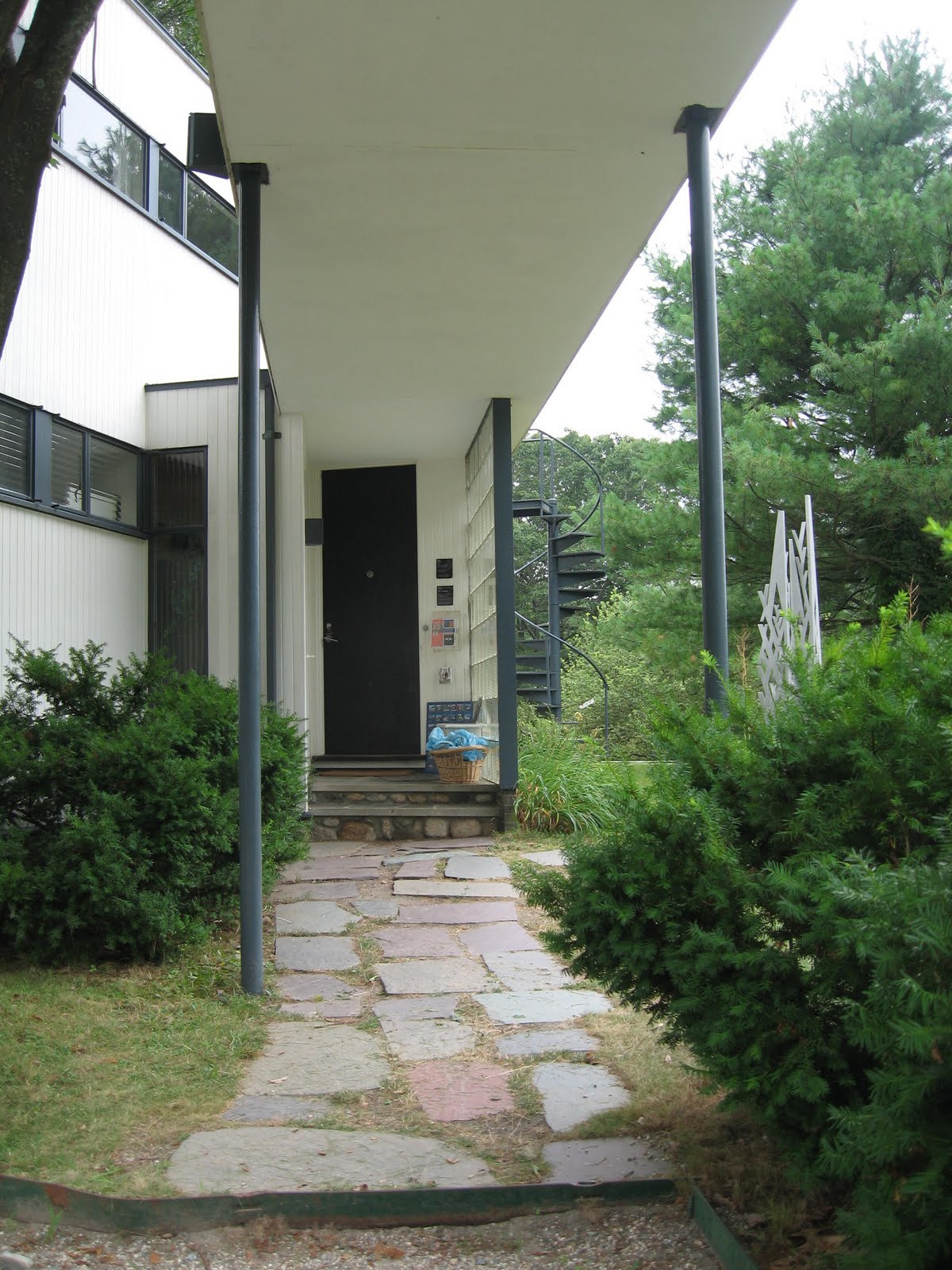
The night before our visit we were having dinner in Chinatown with old friends from the Boston area. I told them about our planned visit to the house the next day and asked if they were familiar with the architect. Of course! Kathy's childhood home on Moon Hill was part of a Lexington, MA street of homes designed by the Architects' Collaborative, a Gropius lead architectural firm. And in addition her Dad had purchased a Concord,MA home that was a close copy of the Gropius home. I was intrigued and short on time. So we choose to visit the nearby close copy only and I think you'll see from the photo just how close it is!


We had plans in Western Massachusetts for the evening so we couldn't linger as long as we'd have liked. We'll be back to visit the wonderful DeCordova museum which is just down the road and to ask our friend Kathy for a tour of Moon Hill.
(Note: The one really bad photo at the top of this entry is a copy of the one on the Historic New England brochure. Because of the way the landscaping has matured its tough to get a good photo of the house from the front without walking out into the field and you know how I'm ever fearful of ticks and Lyme Disease. All the rest were taken by me that day.)